01 / Rankings
Pure Sequence outranks Sequence, then Colour
Pure Sequence requires consecutive ranks in one suit; impure Sequence requires consecutive ranks across mixed suits; Colour requires one suit with separated ranks. Their classic order is Pure Sequence, Sequence, then Colour. Checking the rank pattern and suit pattern independently explains why a mixed-suit run outranks a higher-looking suited hand.
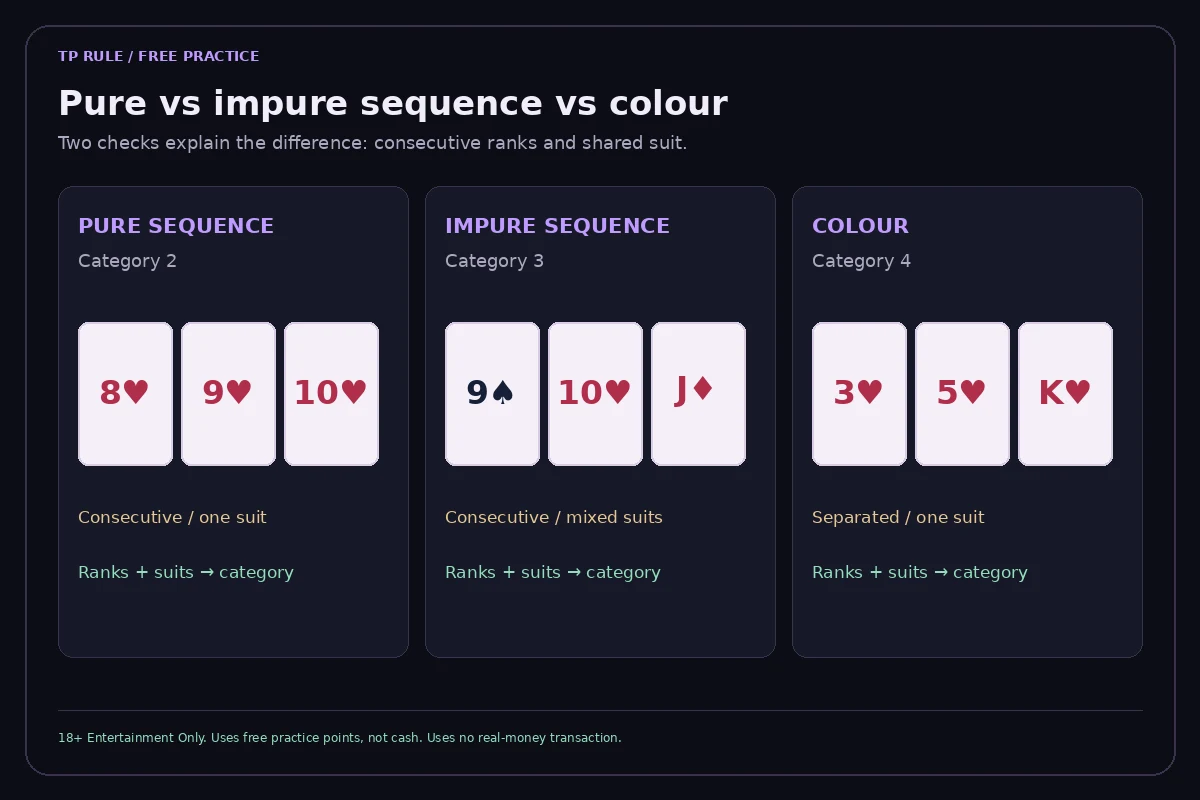
| Check | Pure Sequence | Impure Sequence | Colour |
|---|---|---|---|
| Consecutive ranks | Yes | Yes | Separated |
| Shared suit | Yes | Mixed suits | Yes |
| Category position | 2 | 3 | 4 |
02 / Rankings
Work through a three-way comparison
A three-way exercise makes the category rule visible. Compare 6♥ 7♥ 8♥, Q♣ K♦ A♠ and A♥ J♥ 8♥ as separately dealt example hands. The first is a Pure Sequence, the second an impure Sequence and the third a Colour. Category position determines the order before the aces become relevant.
- Recognise the suited run
6♥ 7♥ 8♥ has consecutive values and one suit, so it is a Pure Sequence.
- Recognise the mixed run
Q♣ K♦ A♠ has consecutive values across suits, so it is an impure Sequence.
- Recognise the colour
A♥ J♥ 8♥ shares a suit with separated values, so it follows both run categories.
03 / Rankings
Use a different key once categories match
Equal-category comparisons use the information that distinguishes hands inside that category. Two sequences follow the declared run order, while two colours compare their descending ranks one at a time. This is why A-J-8 outranks A-10-9 within Colour: the aces match and the jack settles the next comparison.
Original Practice Hand 032
Compare a colour from the top down
Against A♥ 10♥ 9♥, the aces tie at the first comparison. The jack then outranks the ten. The eight is considered only after both earlier ranks match.