01 / Rankings
Each category has its own comparison key
Teen Patti comparison has two layers: category priority, followed by the rank key inside that category. Trails use their shared rank; runs use the agreed sequence order; pairs use pair rank then kicker; colours and high cards compare descending ranks. Following the correct key makes close-looking hands much easier to explain.
| Category | First comparison | Next comparison |
|---|---|---|
| Trail / set | Rank shared by all three cards | Exact-tie procedure |
| Pure or impure sequence | Declared run position | Exact-tie procedure |
| Colour | Highest card | Second rank, then third |
| Pair | Pair rank | Kicker |
| High card | Highest card | Second rank, then third |
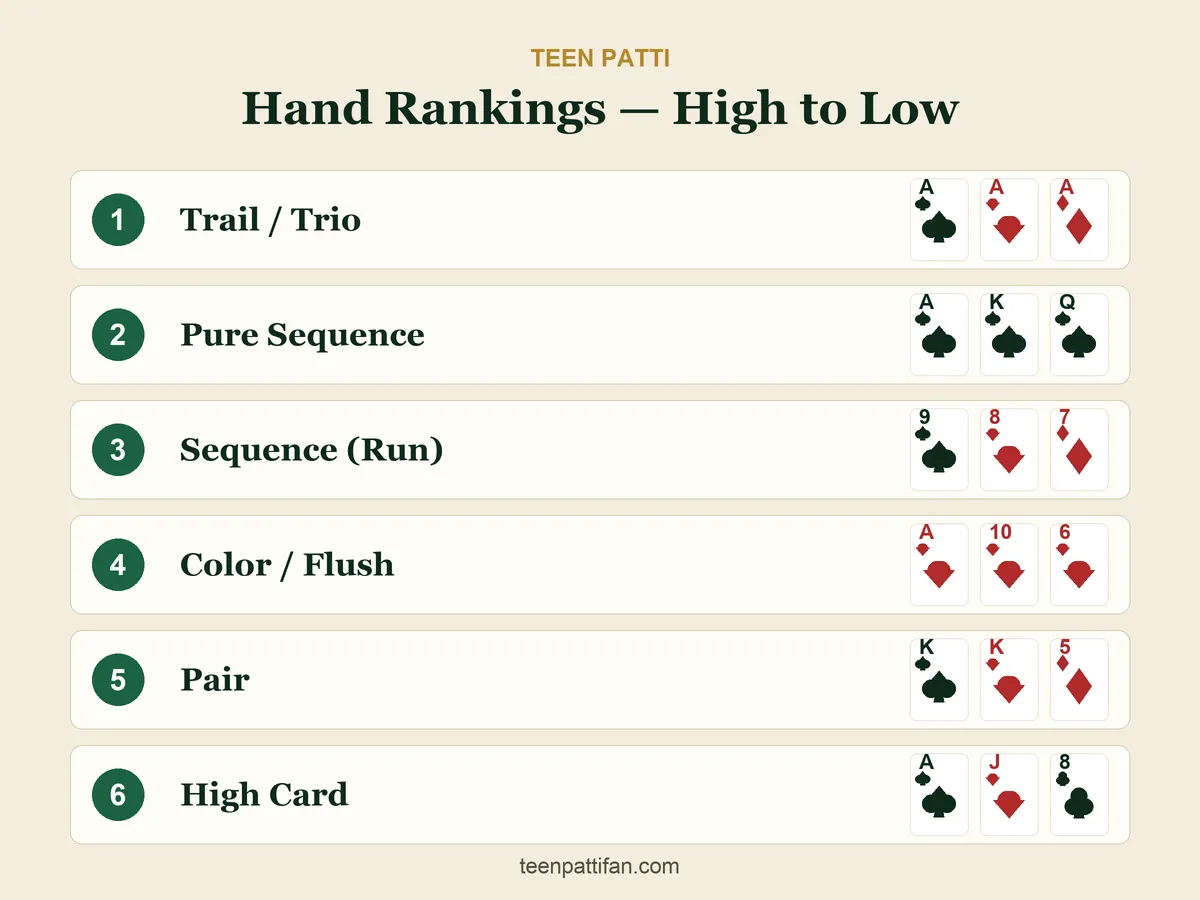
Return to the Teen Patti Master guide’s ace-rule example to see why the same ranks can produce a different result when the declared convention changes.
Compare two complete hands
Choose six distinct cards from the standard pack and declare the ace-run order. Compare the category first, then inspect the rank or kicker that decides the result. This is a fixed-card learning exercise with free practice points.
Hand A ranks higher. Hand A: Pure Sequence. Hand B: Sequence / impure sequence. Category priority decides this comparison.
Equal rank patterns follow the declared requester procedure. Read the exact-tie explanation alongside the card result.
02 / Rankings
A kicker settles matching pairs
A kicker is the third card beside a matching pair, and it becomes decisive when both players hold the same pair rank. Compare K-K-A with K-K-Q: the kings match, so the ace kicker leads. This method works independently of the suits, subject to the table’s declared rule for an exact equal hand.
Original Practice Hand 041
Equal kings, different kickers
Against K♣ K♦ Q♥, both pairs are kings. Compare A♦ against Q♥ next: the ace kicker is higher. All six displayed cards are distinct.
03 / Rankings
Separate equal ranks from the requester procedure
Two hands can share the same rank pattern while using different suits. At that point, the table’s exact-tie procedure becomes the relevant rule. The traditional reference makes the requester yield an exact equal comparison in a sideshow or final show. Agree this convention before practice and record the requester alongside the displayed hands.
Original Practice Hand 042: A♠ J♦ 8♣ versus A♥ J♣ 8♦. Both are the same High Card rank pattern. Every rank comparison matches, so apply the stated requester procedure.
Use a two-column practice record: “card result” and “procedure result”. This keeps the meaning of an exact equal hand clear.